Wanda
Mariners' Museum, Uncurated Search Results
Type: Skipjack
Year: 1897
Builder: John T. Landon
Location: Wittman

These records are found in the online catalog of The Mariners’ Museum and Park in Newport News, Virginia. Uncurated search results are presented to give researchers and interested readers an idea of whether the museum’s archives contain information about this vessel and whether it may be worthwhile to visit the museum’s catalog search page for further investigation. Uncurated results may be inaccurate or incomplete.
Search mode: Exact Name. Search phrase(s): "Wanda". Results returned: 16. Results displayed in this table: 16.
Use these buttons to send uncurated search results to your own app or text document for further research. First, check the box for any row, or click "Select All" then uncheck any rows. Then click "Show Selections". You can then copy your selections from the text box and past them into your app.
| Fetch? | Row ID | Media | Date | Vessel | Place | Related Places | Inscription/Marks | Subject | Notes | Archive Number |
|---|---|---|---|---|---|---|---|---|---|---|
| 1 | 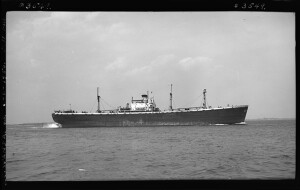 | 6/6/1950 | S.S. Wanda. U.S. 6-6-1950. f11 1-100. / #3549. | Steamboats.; Bodies of water.; Merchant ships. | Broadside view of the steamer Wanda under way. | P0006/02.01-03.2248#01 | ||||
| 2 | 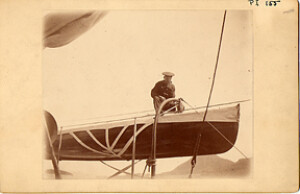 | Photo from starboard bow of lifeboat in davits; a sailor is kneeling on the canvas cover of the lifeboat. | P0001.009/01-#PI0155 | |||||||
| 3 | 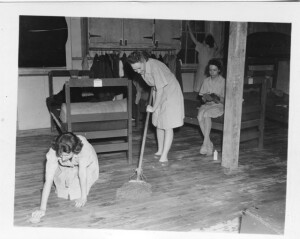 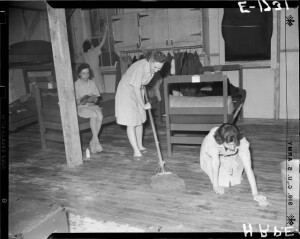 | 4/23/1943 | United States. Army. Women's Army Auxiliary Corps. Post Headquarters Company, 71st.; United States. Army. Women's Army Auxiliary Corps–Barracks and quarters. | Auxiliary Shirley Miller, Wanda Marsh, Alice Johnson during their regular Friday night barracks clean-up, HRPE Newport News, Virginia 5-23-43 Official photograph U.S.Army Signal Corps, HRPE, Newport New,s, Virginia | Cleaning. | Private Shirley Miller scrubbing the floor, Private Wanda Marsh mopping the floor, and Private Helen Johnson shining shoes in the WAACs barracks. A fourth woman is cleaning a window in the background. | P0003/01-#E-1731 | |||
| 4 | 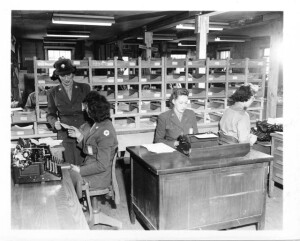 | 4/23/1943 | United States. Army. Women's Army Auxiliary Corps. Post Headquarters Company, 71st.; Port of Embarkation, Hampton Roads, Va. (U.S.). Message Center. | Auxiliaries of the 71st WAAC Hqrs. engaged in office work. 4-23-43 Official photograph U..S. Army Signal Corps, HRPE, Newport News, Virginia | Stenographers–Virginia–Newport News.; Offices–Virginia–Newport News. | Private Ailine Landry, Private Catherine Glazier, Private Wanda Marsh, and Private Isabel Myers working as stenographers in the Message Center. | P0003/01-#E-1743 | |||
| 5 | 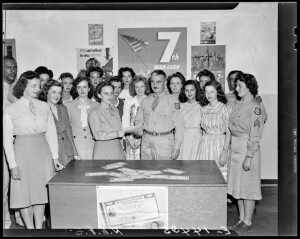 | 6/25/1945 | United States. Army–Officers.; United States. Army. Women's Army Corps. | Col. Emmett G., Lenihan, 0472435, Seattle, Washington, Base Commandant, is shown congratulating Lt. Elizabeth W. Bianchi, L-201120, Brooklyn, N.Y., Base WAC bond officer at NAB, for the fine job that she and her committee did in achieving their goal. Left to right: front row, T/5 Helen C. Berkemer, 504612, Columbus, Ohio; Miss Wanda Dodgion, 2300 Vinvient Ave., Norfolk, Va.; Mrs. Wanda Williamson, 890 Batetourt St., Norfolk, Va.; Miss Lillian Hodges, 7218 Ralph St., Norfolk, Va.; Miss Florence Kelly, 1037 Ingleside Rd., Broad Creek, Norfolk, Va.; Mrs. June Blair, 104 D Suburban Parkway, Norfolk, Va., Miss Kathryn Wright, 1427 West 50 St., Norfolk, Va.; Sgt. Amy C. Bastiani, 609435, Milwaukee, Wisc. Rear row, left to right: Sgt. George M. Bells, 34327570, Columbia, Tenn.; Miss Beverly Brenner, 1040 Brandon Ave., Norfolk, Va.; Miss Vera D.B. Miller, 1019 Jamestown Crescent, Norfolk, Va.; Miss Mary Lou Hensley, 3709 Sewells Pt. Rd., Norfolk, Va.; Pfc Sidney (Minute) Mann, 32640650, Bronx, N.Y.; THese were the Minute men for the 7th War Load Drive who succeeded in putting their section over their quotas more than 3 weeks before the drive ended and thus helping put the Norfolk Army Base as a whole, over its quota. | Fund raising–Virginia–Norfolk.; War posters, American–Virginia–Norfolk. | Shows eighteen individuals, mostly civilian women, gathered around a table covered with war bonds. The wall behind them is decorated with war posters. | P0003/01-#E-14495 | |||
| 6 | 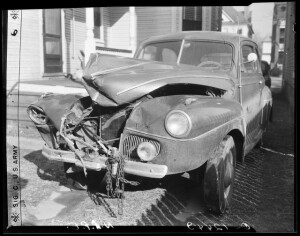 | 2/15/1945 | Photo of damaged civilian car, driven by Bryon Wilson Smithwich, Coxswain, Serial No. 5500345, stationed at Navy Receiving Station, Norfolk, Va., home, North Carolina. License No. N.C.-559704, which collided with 1/2 ton open cab truck driven by Wanda L. Latos, ASN 301164, home, New Castle, Pa. Accident occurred at Westover Ave. and Hampton Blvd., Norfolk, Va., 2 Feb. 45 at 1530. Photo taken for Port Claims Office, NAB, HRPE, Norfolk, Va. | Accident investigation–Virginia–Norfolk.; Automobiles–Collision damage–Virginia–Norfolk. | Shows the front end of a car, the hood and passenger side front fender have been badly damaged. | P0003/01-#O-12449 | ||||
| 7 | 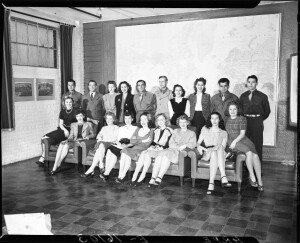 | 11/22/1945 | Norfolk Army Base victory bond minutemen in group. Left to right, front row: Anna B. King, Dayton , Ohio; Arline Frizzell, Norfolk, VA.; Wanda Doghion, Russell, KY.; Virginia A. Boyd, Hilton Village, VA.; C. Shepard, Hazard, KY.; Julia Hall, Asheville, N.C.; Mrs Evelyn W. Owens, Newport News, VA. Back row: left to right: Henry Brodie, Lt. Pittsburgh, PA.; Max A Dey, Macon, GA.; Julia Dixon, Norfolk, VA.; Irene B. Katzman, Norfolk, VA.; Cpl Sidney Mann, Bronx, N.Y.; S/Sgt. Harold M. Cole, Meadowville, VA.; Catherine Venuto, Norfolk, VA.; Mrs. Virginia Chard, Syracuse, N.Y.; Alfred H. Conte, Sgt., Staten Island, N.Y.; and Lt. Eugene Brinker, New Rochelle, N.Y. | Liberty bonds–Virginia–Norfolk.; Fund raising–Virginia–Norfolk. | Group portrait of 19 men and women, mostly civilians. The front row is seated and the back row is standing. The group is arranged before a wall sized world map. | P0003/01-#E-16103 | ||||
| 8 | 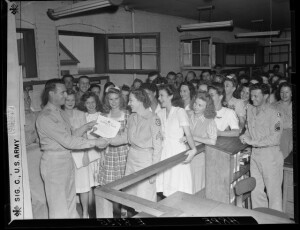 | 7/17/1944 | Port of Embarkation, Hampton Roads, Va. (U.S.). | E8735 - Capt. D. E. Babcock, A.G. of HRPE, shown presenting suggestion award to Sgt. Wanda L. Marsh of A.G. Section. 7-17-44 Official Photograph, U. S. Army Signal Corps, HRPE, Newport News, Va. | Military ceremonies, honors, and salutes–Virginia–Newport News. | Capt. Babcock shakes hands with a woman with a Sergeant's stripes while handing her a certificate. They stand in a room at the front of a crowd of women in civilian clothes. | P0003/01-#E-8735 | |||
| 9 | 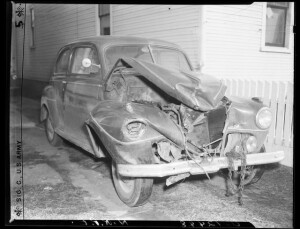 | 2/15/1945 | Photo of damaged civilian car, driven by Bryon Wilson Smithwich, Coxswain, Serial No. 5500345, stationed at Navy Receiving Station, Norfolk, Va., home, North Carolina. License No. N.C.-559704, which collided with 1/2 ton open cab truck driven by Wanda L. Latos, ASN 301164, home, New Castle, Pa. Accident occurred at Westover Ave. and Hampton Blvd., Norfolk, Va., 2 Feb. 45 at 1530. Photo taken for Port Claims Office, NAB, HRPE, Norfolk, Va. | Accident investigation–Virginia–Norfolk.; Automobiles–Collision damage–Virginia–Norfolk. | Shows the front end of a car, the hood and passenger side front fender have been badly damaged. | P0003/01-#O-12448 | ||||
| 10 | 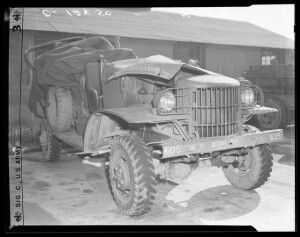 | 2/15/1945 | Photo of damaged 1/2 ton open cab truck, driven by Wanda L. Latos, ASN 301164, home, New Castle, Pa., which collided with Civilian car, driven by Bryon Wilson Smithwick, Coxswain, Serial No. 5500345, stationed at Navy Receiving Station, Norfolk, Va., home, North Carolina. Civilian license No., N.C. 559704. Accident occurred at Westover Ave. and Hampton Blvd., Norfolk, Va., 2 Feb. 45 at 1530. Photo taken for Port Claims Office, NAB, HRPE, Norfolk, Va. | Accident investigation–Virginia–Norfolk.; Automobiles–Collision damage–Virginia–Norfolk.; Military trucks–Virginia–Norfolk. | Shows the front end of a jeep-like vehicle. The damage seems to be located on the passenger side engine access hood. | P0003/01-#O-12450 | ||||
| 11 | 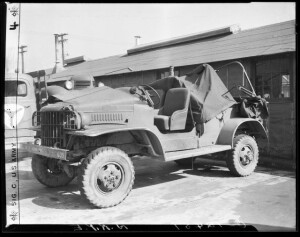 | 2/15/1945 | Photo of damaged 1/2 ton open cab truck, driven by Wanda L. Latos, ASN 301164, home, New Castle, Pa., which collided with Civilian car, driven by Bryon Wilson Smithwick, Coxswain, Serial No. 5500345, stationed at Navy Receiving Station, Norfolk, Va., home, North Carolina. Civilian license No., N.C. 559704. Accident occurred at Westover Ave. and Hampton Blvd., Norfolk, Va., 2 Feb. 45 at 1530. Photo taken for Port Claims Office, NAB, HRPE, Norfolk, Va. | Accident investigation–Virginia–Norfolk.; Automobiles–Collision damage–Virginia–Norfolk.; Military trucks–Virginia–Norfolk. | Shows the front end of a jeep-like vehicle. The damage seems to be located on the passenger side engine access hood. | P0003/01-#O-12451 | ||||
| 12 | 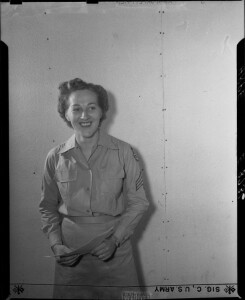 | 7/17/1944 | Port of Embarkation, Hampton Roads, Va. (U.S.).; United States. Army. Women's Army Corps. | E8736 -Head shot of Sgt. Marsh. 7-17-44 Official Photograph, U. S. Army Signal Corps, HRPE, Newport News, Va. | Portraits–Virginia–Newport News. | Sgt Marsh stands against a white wall, posed for a portrait in her summer uniform. | P0003/01-#E-8736 | |||
| 13 | 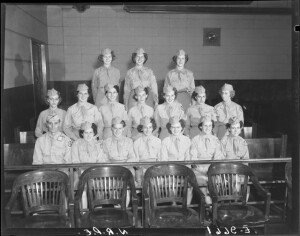 | 9/6/1944 | United States. Army. Women's Army Corps–Sports.; Port of Embarkation, Hampton Roads, Va. (U.S.). | E-9661 - Shown is a group picture of the WAC softball team. 9-6-44 Official Photograph, U. S. Army Signal Corps, HRPE, Newport News, Va. | Softball players–Virginia–Newport News.; Portraits, Group–Virginia–Newport News. | Shows WACs and one male soldier posing in three rows, the rear standing and the front two seated. They all wear uniforms with side caps. | P0003/01-#E-9661 | |||
| 14 | 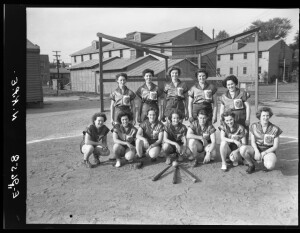 | 9/6/1944 | United States. Army. Women's Army Corps–Sports.; Port of Embarkation, Hampton Roads, Va. (U.S.). 85th Coast Artillery Parade Ground. | E-9658 - HRPE WAC softball team. Photo was taken at the 85th C.A. grounds. 9-6-44 Official Photograph, U. S. Army Signal Corps, HRPE, Newport News, Va. | Softball–Virginia–Newport News.; Softball players–Virginia–Newport News.; Portraits, Group–Virginia–Newport News. | Shows WACs posing in two rows, the rear standing and the front kneeling. They all wear softball uniforms with the Transportation Corps logo on the left breast and athletic shoes. In front of them are three bats and a softball, behind them is the backstop and several buildings that resemble Camp Hill. | P0003/01-#E-9658 | |||
| 15 | 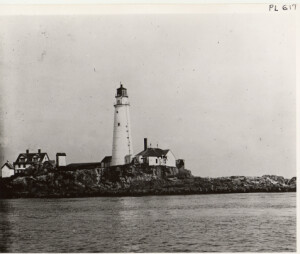 | USA; MASSACHUSETTS; BOSTON | CURATOR NOTES: This was the first light station established on the North American continent, and the last in the United States to be automated. It's also our only light station that still retains an official keeper. Because Boston Light was destroyed in the Revolution and rebuilt in 1783, the tower itself is the second oldest in the U.S. New Jersey's Sandy Hook Light, built in 1764, is the oldest lighthouse tower. Boston's deep and spacious harbor led it to become the commercial center of America in colonial days. At that time, all large vessels had to enter the harbor between the Brewster Islands in the outer harbor and Point Allerton in the town of Hull.It's recorded that there was a beacon on Point Allerton in Hull as early as 1673. The beacon was a simple structure supporting an open iron basket or grate in which "fier-bales of pitch and ocre" were burned. Clough's New England Almanac of 1701 hinted at the need for a lighthouse at the entrance to the harbor. Early in 1713, a prominent Boston merchant and selectman named John George, representing the business community of the city, proposed to the General Court the "Erecting of a Light Hous & Lanthorn on some Head Land at the Entrance to the Harbour of Boston for the Direction of Ships & Vessels in the Night Time bound into the said Harbour." A committee headed by Lieutenant Governor William Tailer planned for the lighthouse. After visiting several of the harbor islands and conferring with the area's most experienced shipmasters, Tailer reported that the best site for the lighthouse was "the Southernmost Part of the Great Brewster called Beacon Island." Beacon Island, now known as Little Brewster, is attached to Great Brewster by a sand bar. On July 23, 1715, the General Court of Massachusetts passed the Boston Light Bill. It read, in part: Whereas the want of a lighthouse erected at the entrance to the harbor of Boston hath been a great discouragement to navigation by the loss of the lives and estates of several of his majesty's subjects; for prevention thereof Be it enacted...that there be a lighthouse erected at the charge of the Province, on the southernmost part of the Great Brewster, called Beacon Island, to be kept lighted from sun setting to sun rising. The first lighthouse was financed by a tax of a penny a ton on all vessels coming into the harbor, and the same amount for vessels leaving the harbor. Smaller coasting vessels paid only two shillings as they left the harbor. Fishing vessels and small vessels transporting lumber and other building materials locally were taxed five shillings yearly. The exact dimensions of the original stone tower aren't known, but it's believed it was at least 50 feet tall. The first keeper, 43-year-old George Worthylake, lighted the lighthouse on Friday, September 14, 1716. 1729 engraving Worthylake, who was brought up on George's Island in Boston Harbor, moved to the light station with his wife, Ann, and their daughters, Ruth and Ann. An African slave named Shadwell lived at the lighthouse as well. Worthylake also maintained a farm on Lovell's Island, closer to Boston. He was paid £50 a year, which was raised to £75 in 1717. Worthylake made additional money as a harbor pilot, and he also kept a flock of sheep on Great Brewster Island. Fifty-nine of his sheep were caught on the long sand spit off Great Brewster during a 1717 storm, and they drowned when the tide came in. On November 3, 1718, Worthylake went to Boston to collect his pay. On his way back he stopped at Lovell's Island, where he and his wife and their daughter Ruth boarded a sloop heading for Boston Light. A friend, John Edge, accompanied them. The sloop anchored near Little Brewster Island a few minutes past noon, and Shadwell paddled out in a canoe to transfer the party to the island. Young Ann Worthylake and a friend, Mary Thompson, watched from shore. Suddenly, the two girls on shore saw "Worthylake, his wife & others swimming or floating on the water, with their boat Oversett." The canoe had capsized, and all five people drowned. George, Ann, and Ruth Worthylake were buried beneath a triple headstone in Copp's Hill Burying Ground in Boston's North End. Benjamin Franklin, 12 years old at the time, was urged by his brother to write a poem based on the disaster. Young Franklin wrote a poem called The Lighthouse Tragedy and hawked copies on the streets of Boston. He referred to it years later as "wretched stuff." Not one copy existed until 1940, when Maurice Babcock, Jr., son of Boston Light's keeper, found a tattered copy in the ruins of an old house on Middle Brewster Island, near Little Brewster. The copy could not be proved to be authentic so no value could be placed on it. Robert Saunders, a former sloop captain, became Boston Light's second keeper on a temporary basis, until a new permanent keeper could be chosen. Saunders apparently drowned only a few days after taking the job; no details of the incident survive. John Hayes, an experienced seaman described as an "able-bodied and discreet person," became the next keeper. Hayes asked for a gallery to be installed around the tower's lantern room so that he could clean the glass of ice and snow. Hayes also noted the need for some kind of fog signal, asking that "a great Gun may be placed on the Said Island to answer Ships in a Fogg." A cannon, America's first fog signal, was placed on the island in 1719. It served for well over a century. After some years at the Coast Guard Academy in New London, Connecticut, the cannon was returned by helicopter to its rightful home in 1993. Today the venerable fog cannon sits on a new carriage in the base of the lighthouse tower. John Hayes retired because of advancing age in 1733. Robert Ball, an Englishman whose stay of about 40 years would be the longest stint of any keeper in the station's history, succeeded him. Ball was assisted by a slave known as Samson, who died in 1762 and was buried on Rainsford Island in the harbor. A bad fire gutted the lighthouse in 1751, and for a time the light was shown from a 40-foot spar. The early lighthouse was struck by lightning on several occasions, including an instance in June 1754 when lightning "tore off shingles from several places on the outside." The installation of a lightning rod was delayed because of the objections of some "godly men" who thought it "vanity and irreligion for the arm of flesh to presume to avert the stroke of heaven," according to a 1789 article. Practicality eventually won out and a lightning conductor was installed. In July 1775, Boston Harbor and the lighthouse were under the control of the British. On July 20, American troops under Maj. Joseph Vose landed at the lighthouse and took lamps, oil, and some gunpowder, and burned the wooden parts of the tower. After leaving the island they had to outrun an armed British schooner, and two Americans were wounded. An eyewitness described "the flames of the lighthouse ascending up to Heaven, like grateful incense, and the ships wasting their powder." As the British worked to repair the tower, 300 American soldiers under Maj. Benjamin Tupper landed at the island on July 31. They easily defeated the British guard and again burned the lighthouse. As they tried to leave, they found their boats stranded; the tide had gone out. This gave British vessels time to reach the scene. The Americans managed to launch their boats as the British fired on them. American troops at Nantasket in Hull helped by firing a cannon at the British boats, landing a direct hit on one. This turned the tide of battle and the Americans escaped with only one soldier killed. George Washington praised the "gallant and soldier-like behavior" of the men under Major Tupper. At the end of their occupation of Boston Harbor during the Revolution, the British lingered in the harbor for some months. As they left the area on June 13, 1776, one of their final acts was to set off a timed charge on Little Brewster, completely destroying the lighthouse. The remains of the metal lantern were used to make ladles for American cannons. It took until 1783 for Boston Light to be rebuilt. The new 75-foot rubblestone tower, built by the order of John Hancock, governor of Massachusetts, was designed "to be nearly of the same dimensions of the former lighthouse." It has sometimes been claimed that part of the original tower was incorporated into the new one, but there is no evidence to support this claim. Thomas Knox was the first post-Revolution keeper. He stayed in the position for 27 years, also serving as a harbor pilot. The light station was ceded to the federal government in 1790. In June 1809, the local lighthouse superintendent, Henry Dearborn, found three perpendicular cracks in the tower, extending for almost its entire height. Six iron hoops were added around the tower for extra support. One band was removed in the early twentieth century; five aluminum bands are in place today. Winslow Lewis installed a new lantern in 1839, along with new 21-inch reflectors from England. The engineer I. W. P. Lewis, Winslow's nephew, visited Boston Light for his 1843 report to Congress. He was critical, calling the tower "loose and leaky," and noting that the wooden stairway was so rotten "as to be unsafe of ascent." The two-story house, with four rooms on each floor, was in good repair, as was a new boathouse. A 1,375-pound fog bell, operated by clockwork machinery, replaced the old cannon in 1851. Moses Barrett, a Gloucester native, saw much change during his time as keeper (185662). The Lighthouse Board had suggested in 1857 that the tower be rebuilt at a cost of $71,000, but improvements were made instead. Boston Light and the 1859 duplex keeper's house In 1859, the tower was raised to its present height of 89 feet and a new lantern was installed along with a 12-sided second-order Fresnel lens. The giant lens about 11 feet tall and 15 feet in circumference rotated by means of a clockwork mechanism that required frequent winding. A single lamp inside the new lens replaced the system of multiple lamps, and round "bull's-eye" panels on the lens produced a flash each time they passed in front of the light source. The lens went into operation on December 20, 1859. In the same year, the tower was lined with brick, a spacious brick entryway was added to the tower, and a new duplex keeper's house was built. Beginning in 1861, Boston Light was assigned a keeper and two assistants. Thomas Bates took over as keeper in July 1864 and remained until his death in April 1893. The light station was the scene of many happy gatherings during the Bates era. Frequent sing-alongs took place, with the accompaniment of Assistant Keeper Edward Gorham on accordion. When the Roll Is Called Up Yonder and Crossing the Bar were special favorites. On January 31, 1882, Keeper Bates, along with an assistant and a local fisherman, rescued the crew of the Fanny Pike, which had run into Shag Rocks. A brick cistern was added in 1884 in a building near the tower. The cistern held 21,800 gallons of rainwater for the keepers and their families. A second keeper's house was added in 1885, located at the opposite end of the island from the lighthouse. Two houses had become a necessity with three keepers and their families living on the island. Thomas Bates, Jr., Keeper of Boston Light 1864-1893 Three keepers of Boston Light: Charles Jennings, Maurice Babcock, and J. Lelan Hart. From the collection of Edward Rowe Snow, courtesy of Dorothy Bicknell A Daboll compressed-air trumpet replaced the fog bell in 1872 and remained in use until 1887, when it was replaced by a steam-driven siren. In the late 1800s, students from the Massachusetts Institute of Technology conducted experiments with fog signals at Boston Light, trying to perfect a signal that would penetrate the so-called "ghost walk," an area about six miles east of the lighthouse where no sound could penetrate. Despite the students' efforts, even the largest horn could not penetrate the "ghost walk." Maurice Babcock was keeper from 1926 to 1941, when the Coast Guard took over the operation of Boston Light. In 1934, members of the Bostonian Society and the Massachusetts Historical Society held a ceremony on Little Brewster honoring the 25 keepers of Boston Light. Fitz-Henry Smith, author of a history of the lighthouse, unveiled a tablet bearing the names of the keepers. Keeper Babcock was invited to speak. Here is the entire text of his speech: Well, ladies and gentlemen, I am not much of an orator, but I enjoy keeping the light burning for the ships coming in, and the fog signal sounding. I thank you. Maurice Babcock Just after their retirement, Keeper Babcock's wife told the Boston Post, "You don't surrender a 23-year routine without regret. But, all in all, we're glad to be back in the world again." The Babcocks' son Bill carried on the family tradition, becoming a keeper at Graves Light in Boston Harbor. Georgia Norwood Ralph Norwood, who had been an assistant under Maurice Babcock, enlisted in the Coast Guard and became the next head keeper. Click here to hear a recording of Keeper Norwood describing his duties at Boston Light (courtesy of his grandson, Willie Emerson). The 1930s had been exciting years for the Norwoods. In 1932, Josephine Norwood, wife of the assistant keeper, was expecting their seventh child. The birth seemed imminent the night of a terrible storm. Dr. Walter H. Sturgis of Hull made the trip to Little Brewster, but it was a false alarm. Mrs. Norwood had her child in calm weather a week later. Nevertheless a legend was born; Georgia Norwood became famous as the "Storm Child." When Georgia was five, author Ruth Carmen visited Hull and heard the story. Carmen wrote a novel called Storm Child, a highly fictionalized version of the Norwoods' story that even included a tidal wave destroying the lighthouse. Hollywood became interested and a movie version was planned, with little Georgia to play herself. Described as "smiling and sunny-curled," Georgia Norwood was to be the "Bay State's own Shirley Temple." At the last moment, Ralph and Josephine Norwood decided against letting Georgia go to Hollywood they thought she'd have a happier life at home with her family. Apparently Georgia agreed, as she reportedly said, "I don't want to go to Hollywood. I want to go back to Boston Light." The legend of the Storm Child lived on just the same, as Georgia's son later wrote a book called First Light telling the true story of his mother's birth and life at Boston Light. In the 1930s, one-acre Little Brewster Island was home to as many as 19 children among the three keepers' families. Summers were lively with rowboat races and pie eating contests with the children summering on nearby Great Brewster. The older children made money by lobstering. Games of all sorts were played, even baseball in the water was out. Life was mostly harmonious, although Maurice Babcock, Jr. did get a punch in the nose once from one of the Norwood girls; he had trespassed onto the Norwoods' part of the island. Bruce Norwood said years later, "I've never been in another place that felt like the home Boston Light was." The Norwood family in 1946 Back row: Georgia, Wanda, Fay, Josephine, Ralph Front row: Bob, Bruce, Dexter, Priscilla, Gail, Ralph II, Spunky Courtesy of Willie Emerson Courtesy of Willie Emerson In the winters, the children boarded in Hull or Winthrop where they attended school, waiting eagerly for vacations and their glorious summers back on Little Brewster. Boston Light was extinguished during World War II, going back into operation in July 1945. The light was electrified in 1948 and shortly after that the clockwork mechanism that rotated the lens was replaced by an electric motor. The original Fresnel lens remains in use today. In 1960, it was decided that the smaller 1885 keeper's house would suffice for the Coast Guard keepers. The 1859 duplex house, which had badly deteriorated, was burned down by the Coast Guard. The remaining 1885 keeper's house Boatswain's Mate First Class William "Mike" Mikelonis was the Coast Guard keeper at Boston Light for several years beginning in 1962. The Coast Guard staff then spent two weeks on the island and one week off. Mikelonis and other keepers over the years have enjoyed great fishing off the ledges. When Mikelonis retired in 1967, he reportedly had caught over 1,000 striped bass, two of them over 50 pounds. On his retirement Mikelonis was presented with the bulb that burned in the tower on his last day of duty. Mikelonis shared the island with two assistants and a shaggy black dog named Salty, one of a long line of Boston Light dogs. Salty was succeeded by Salty II and later by Farah, a friendly mutt who lived for 13 years on Little Brewster and reportedly would whine and shake when she was taken to the mainland. Coast Guardsmen claimed it was a "tradition" to paint Farah's toenails pink. Click here to see a video clip of Farah in the late 1980s. Another dog was named Shadwell in honor of the slave who drowned with the first keeper. Cats have also lived at the light, including a recent frisky black cat named Ida Lewis, after America's most famous woman lighthouse keeper. Some keepers have reported odd happenings on Little Brewster. Dennis Dever, Coast Guard keeper in the late 1980s, reported that his radio would mysteriously change stations by itself, from rock to classical. One day, Dever claimed, he was sitting in the kitchen of the keeper's house looking out the window at the tower, and he clearly saw a man in the lantern room. This was quite alarming, as the only other person on the island was his assistant James McClurkin, who was in the next room. From a distance it appeared that the figure at the top of the tower was wearing an old fashioned keeper's uniform. Dever rushed to the tower and went up the stairs, finding the lantern room empty. Dever and other keepers have blamed events like these on "old George," Worthylake, that is. In 1999, Coast Guard Petty Officer Gary Fleming told the Boston Herald, "It really does get spooky. You have plenty of time here and if you let your mind go, you can freak yourself out." By 1989, the Coast Guard had automated every lighthouse in the United States and Boston Light was scheduled to be the last in this process. Preservation groups appealed to Congress and the Coast Guard, and with the help of Senator Edward M. Kennedy funding was appropriated to keep Coast Guard staff on Little Brewster, making the island a living museum of lighthouse history. In 1990, Historic Boston, Inc., and the Massachusetts Department of Environmental Management commissioned a Stewardship Plan and preservation guidelines for Boston Light. As a result of the study, much work has been done on the island in recent years, including the replacing of trim on the keeper's house and the repainting of all the buildings. This small museum of artifacts in the base of the tower was started by CWO Ken Black, officer in charge at Coast Guard Station Point Allerton in the 1960s Boston Light became the last lighthouse in the United States to be automated on April 16, 1998, but a Coast Guard crew continued to perform all the other traditional keepers' duties except for turning the light on at sunset and turning it off at sunrise. The light currently operates 24 hours a day. | P0001.012/01-#PL617 | ||||||
| 16 | 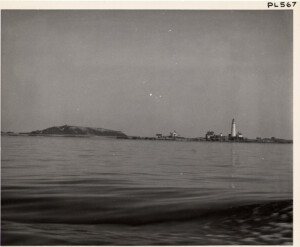 | MASSACHUSETTS; BOSTON | CURATOR NOTES: Boston Light seen in distance. built 1716, rebuilt 1783, 102 feet high This was the first light station established on the North American continent, and the last in the United States to be automated. It's also our only light station that still retains an official keeper. Because Boston Light was destroyed in the Revolution and rebuilt in 1783, the tower itself is the second oldest in the U.S. New Jersey's Sandy Hook Light, built in 1764, is the oldest lighthouse tower. Boston's deep and spacious harbor led it to become the commercial center of America in colonial days. At that time, all large vessels had to enter the harbor between the Brewster Islands in the outer harbor and Point Allerton in the town of Hull.It's recorded that there was a beacon on Point Allerton in Hull as early as 1673. The beacon was a simple structure supporting an open iron basket or grate in which "fier-bales of pitch and ocre" were burned. Clough's New England Almanac of 1701 hinted at the need for a lighthouse at the entrance to the harbor. Early in 1713, a prominent Boston merchant and selectman named John George, representing the business community of the city, proposed to the General Court the "Erecting of a Light Hous & Lanthorn on some Head Land at the Entrance to the Harbour of Boston for the Direction of Ships & Vessels in the Night Time bound into the said Harbour." A committee headed by Lieutenant Governor William Tailer planned for the lighthouse. After visiting several of the harbor islands and conferring with the area's most experienced shipmasters, Tailer reported that the best site for the lighthouse was "the Southernmost Part of the Great Brewster called Beacon Island." Beacon Island, now known as Little Brewster, is attached to Great Brewster by a sand bar. On July 23, 1715, the General Court of Massachusetts passed the Boston Light Bill. It read, in part: Whereas the want of a lighthouse erected at the entrance to the harbor of Boston hath been a great discouragement to navigation by the loss of the lives and estates of several of his majesty's subjects; for prevention thereof Be it enacted...that there be a lighthouse erected at the charge of the Province, on the southernmost part of the Great Brewster, called Beacon Island, to be kept lighted from sun setting to sun rising. The first lighthouse was financed by a tax of a penny a ton on all vessels coming into the harbor, and the same amount for vessels leaving the harbor. Smaller coasting vessels paid only two shillings as they left the harbor. Fishing vessels and small vessels transporting lumber and other building materials locally were taxed five shillings yearly. The exact dimensions of the original stone tower aren't known, but it's believed it was at least 50 feet tall. The first keeper, 43-year-old George Worthylake, lighted the lighthouse on Friday, September 14, 1716. 1729 engraving Worthylake, who was brought up on George's Island in Boston Harbor, moved to the light station with his wife, Ann, and their daughters, Ruth and Ann. An African slave named Shadwell lived at the lighthouse as well. Worthylake also maintained a farm on Lovell's Island, closer to Boston. He was paid £50 a year, which was raised to £75 in 1717. Worthylake made additional money as a harbor pilot, and he also kept a flock of sheep on Great Brewster Island. Fifty-nine of his sheep were caught on the long sand spit off Great Brewster during a 1717 storm, and they drowned when the tide came in. On November 3, 1718, Worthylake went to Boston to collect his pay. On his way back he stopped at Lovell's Island, where he and his wife and their daughter Ruth boarded a sloop heading for Boston Light. A friend, John Edge, accompanied them. The sloop anchored near Little Brewster Island a few minutes past noon, and Shadwell paddled out in a canoe to transfer the party to the island. Young Ann Worthylake and a friend, Mary Thompson, watched from shore. Suddenly, the two girls on shore saw "Worthylake, his wife & others swimming or floating on the water, with their boat Oversett." The canoe had capsized, and all five people drowned. George, Ann, and Ruth Worthylake were buried beneath a triple headstone in Copp's Hill Burying Ground in Boston's North End. Benjamin Franklin, 12 years old at the time, was urged by his brother to write a poem based on the disaster. Young Franklin wrote a poem called The Lighthouse Tragedy and hawked copies on the streets of Boston. He referred to it years later as "wretched stuff." Not one copy existed until 1940, when Maurice Babcock, Jr., son of Boston Light's keeper, found a tattered copy in the ruins of an old house on Middle Brewster Island, near Little Brewster. The copy could not be proved to be authentic so no value could be placed on it. Robert Saunders, a former sloop captain, became Boston Light's second keeper on a temporary basis, until a new permanent keeper could be chosen. Saunders apparently drowned only a few days after taking the job; no details of the incident survive. John Hayes, an experienced seaman described as an "able-bodied and discreet person," became the next keeper. Hayes asked for a gallery to be installed around the tower's lantern room so that he could clean the glass of ice and snow. Hayes also noted the need for some kind of fog signal, asking that "a great Gun may be placed on the Said Island to answer Ships in a Fogg." A cannon, America's first fog signal, was placed on the island in 1719. It served for well over a century. After some years at the Coast Guard Academy in New London, Connecticut, the cannon was returned by helicopter to its rightful home in 1993. Today the venerable fog cannon sits on a new carriage in the base of the lighthouse tower. John Hayes retired because of advancing age in 1733. Robert Ball, an Englishman whose stay of about 40 years would be the longest stint of any keeper in the station's history, succeeded him. Ball was assisted by a slave known as Samson, who died in 1762 and was buried on Rainsford Island in the harbor. A bad fire gutted the lighthouse in 1751, and for a time the light was shown from a 40-foot spar. The early lighthouse was struck by lightning on several occasions, including an instance in June 1754 when lightning "tore off shingles from several places on the outside." The installation of a lightning rod was delayed because of the objections of some "godly men" who thought it "vanity and irreligion for the arm of flesh to presume to avert the stroke of heaven," according to a 1789 article. Practicality eventually won out and a lightning conductor was installed. In July 1775, Boston Harbor and the lighthouse were under the control of the British. On July 20, American troops under Maj. Joseph Vose landed at the lighthouse and took lamps, oil, and some gunpowder, and burned the wooden parts of the tower. After leaving the island they had to outrun an armed British schooner, and two Americans were wounded. An eyewitness described "the flames of the lighthouse ascending up to Heaven, like grateful incense, and the ships wasting their powder." As the British worked to repair the tower, 300 American soldiers under Maj. Benjamin Tupper landed at the island on July 31. They easily defeated the British guard and again burned the lighthouse. As they tried to leave, they found their boats stranded; the tide had gone out. This gave British vessels time to reach the scene. The Americans managed to launch their boats as the British fired on them. American troops at Nantasket in Hull helped by firing a cannon at the British boats, landing a direct hit on one. This turned the tide of battle and the Americans escaped with only one soldier killed. George Washington praised the "gallant and soldier-like behavior" of the men under Major Tupper. At the end of their occupation of Boston Harbor during the Revolution, the British lingered in the harbor for some months. As they left the area on June 13, 1776, one of their final acts was to set off a timed charge on Little Brewster, completely destroying the lighthouse. The remains of the metal lantern were used to make ladles for American cannons. It took until 1783 for Boston Light to be rebuilt. The new 75-foot rubblestone tower, built by the order of John Hancock, governor of Massachusetts, was designed "to be nearly of the same dimensions of the former lighthouse." It has sometimes been claimed that part of the original tower was incorporated into the new one, but there is no evidence to support this claim. Thomas Knox was the first post-Revolution keeper. He stayed in the position for 27 years, also serving as a harbor pilot. The light station was ceded to the federal government in 1790. In June 1809, the local lighthouse superintendent, Henry Dearborn, found three perpendicular cracks in the tower, extending for almost its entire height. Six iron hoops were added around the tower for extra support. One band was removed in the early twentieth century; five aluminum bands are in place today. Winslow Lewis installed a new lantern in 1839, along with new 21-inch reflectors from England. The engineer I. W. P. Lewis, Winslow's nephew, visited Boston Light for his 1843 report to Congress. He was critical, calling the tower "loose and leaky," and noting that the wooden stairway was so rotten "as to be unsafe of ascent." The two-story house, with four rooms on each floor, was in good repair, as was a new boathouse. A 1,375-pound fog bell, operated by clockwork machinery, replaced the old cannon in 1851. Moses Barrett, a Gloucester native, saw much change during his time as keeper (185662). The Lighthouse Board had suggested in 1857 that the tower be rebuilt at a cost of $71,000, but improvements were made instead. Boston Light and the 1859 duplex keeper's house In 1859, the tower was raised to its present height of 89 feet and a new lantern was installed along with a 12-sided second-order Fresnel lens. The giant lens about 11 feet tall and 15 feet in circumference rotated by means of a clockwork mechanism that required frequent winding. A single lamp inside the new lens replaced the system of multiple lamps, and round "bull's-eye" panels on the lens produced a flash each time they passed in front of the light source. The lens went into operation on December 20, 1859. In the same year, the tower was lined with brick, a spacious brick entryway was added to the tower, and a new duplex keeper's house was built. Beginning in 1861, Boston Light was assigned a keeper and two assistants. Thomas Bates took over as keeper in July 1864 and remained until his death in April 1893. The light station was the scene of many happy gatherings during the Bates era. Frequent sing-alongs took place, with the accompaniment of Assistant Keeper Edward Gorham on accordion. When the Roll Is Called Up Yonder and Crossing the Bar were special favorites. On January 31, 1882, Keeper Bates, along with an assistant and a local fisherman, rescued the crew of the Fanny Pike, which had run into Shag Rocks. A brick cistern was added in 1884 in a building near the tower. The cistern held 21,800 gallons of rainwater for the keepers and their families. A second keeper's house was added in 1885, located at the opposite end of the island from the lighthouse. Two houses had become a necessity with three keepers and their families living on the island. Thomas Bates, Jr., Keeper of Boston Light 1864-1893 Three keepers of Boston Light: Charles Jennings, Maurice Babcock, and J. Lelan Hart. From the collection of Edward Rowe Snow, courtesy of Dorothy Bicknell A Daboll compressed-air trumpet replaced the fog bell in 1872 and remained in use until 1887, when it was replaced by a steam-driven siren. In the late 1800s, students from the Massachusetts Institute of Technology conducted experiments with fog signals at Boston Light, trying to perfect a signal that would penetrate the so-called "ghost walk," an area about six miles east of the lighthouse where no sound could penetrate. Despite the students' efforts, even the largest horn could not penetrate the "ghost walk." Maurice Babcock was keeper from 1926 to 1941, when the Coast Guard took over the operation of Boston Light. In 1934, members of the Bostonian Society and the Massachusetts Historical Society held a ceremony on Little Brewster honoring the 25 keepers of Boston Light. Fitz-Henry Smith, author of a history of the lighthouse, unveiled a tablet bearing the names of the keepers. Keeper Babcock was invited to speak. Here is the entire text of his speech: Well, ladies and gentlemen, I am not much of an orator, but I enjoy keeping the light burning for the ships coming in, and the fog signal sounding. I thank you. Maurice Babcock Just after their retirement, Keeper Babcock's wife told the Boston Post, "You don't surrender a 23-year routine without regret. But, all in all, we're glad to be back in the world again." The Babcocks' son Bill carried on the family tradition, becoming a keeper at Graves Light in Boston Harbor. Georgia Norwood Ralph Norwood, who had been an assistant under Maurice Babcock, enlisted in the Coast Guard and became the next head keeper. Click here to hear a recording of Keeper Norwood describing his duties at Boston Light (courtesy of his grandson, Willie Emerson). The 1930s had been exciting years for the Norwoods. In 1932, Josephine Norwood, wife of the assistant keeper, was expecting their seventh child. The birth seemed imminent the night of a terrible storm. Dr. Walter H. Sturgis of Hull made the trip to Little Brewster, but it was a false alarm. Mrs. Norwood had her child in calm weather a week later. Nevertheless a legend was born; Georgia Norwood became famous as the "Storm Child." When Georgia was five, author Ruth Carmen visited Hull and heard the story. Carmen wrote a novel called Storm Child, a highly fictionalized version of the Norwoods' story that even included a tidal wave destroying the lighthouse. Hollywood became interested and a movie version was planned, with little Georgia to play herself. Described as "smiling and sunny-curled," Georgia Norwood was to be the "Bay State's own Shirley Temple." At the last moment, Ralph and Josephine Norwood decided against letting Georgia go to Hollywood they thought she'd have a happier life at home with her family. Apparently Georgia agreed, as she reportedly said, "I don't want to go to Hollywood. I want to go back to Boston Light." The legend of the Storm Child lived on just the same, as Georgia's son later wrote a book called First Light telling the true story of his mother's birth and life at Boston Light. In the 1930s, one-acre Little Brewster Island was home to as many as 19 children among the three keepers' families. Summers were lively with rowboat races and pie eating contests with the children summering on nearby Great Brewster. The older children made money by lobstering. Games of all sorts were played, even baseball in the water was out. Life was mostly harmonious, although Maurice Babcock, Jr. did get a punch in the nose once from one of the Norwood girls; he had trespassed onto the Norwoods' part of the island. Bruce Norwood said years later, "I've never been in another place that felt like the home Boston Light was." The Norwood family in 1946 Back row: Georgia, Wanda, Fay, Josephine, Ralph Front row: Bob, Bruce, Dexter, Priscilla, Gail, Ralph II, Spunky Courtesy of Willie Emerson Courtesy of Willie Emerson In the winters, the children boarded in Hull or Winthrop where they attended school, waiting eagerly for vacations and their glorious summers back on Little Brewster. Boston Light was extinguished during World War II, going back into operation in July 1945. The light was electrified in 1948 and shortly after that the clockwork mechanism that rotated the lens was replaced by an electric motor. The original Fresnel lens remains in use today. In 1960, it was decided that the smaller 1885 keeper's house would suffice for the Coast Guard keepers. The 1859 duplex house, which had badly deteriorated, was burned down by the Coast Guard. The remaining 1885 keeper's house Boatswain's Mate First Class William "Mike" Mikelonis was the Coast Guard keeper at Boston Light for several years beginning in 1962. The Coast Guard staff then spent two weeks on the island and one week off. Mikelonis and other keepers over the years have enjoyed great fishing off the ledges. When Mikelonis retired in 1967, he reportedly had caught over 1,000 striped bass, two of them over 50 pounds. On his retirement Mikelonis was presented with the bulb that burned in the tower on his last day of duty. Mikelonis shared the island with two assistants and a shaggy black dog named Salty, one of a long line of Boston Light dogs. Salty was succeeded by Salty II and later by Farah, a friendly mutt who lived for 13 years on Little Brewster and reportedly would whine and shake when she was taken to the mainland. Coast Guardsmen claimed it was a "tradition" to paint Farah's toenails pink. Click here to see a video clip of Farah in the late 1980s. Another dog was named Shadwell in honor of the slave who drowned with the first keeper. Cats have also lived at the light, including a recent frisky black cat named Ida Lewis, after America's most famous woman lighthouse keeper. Some keepers have reported odd happenings on Little Brewster. Dennis Dever, Coast Guard keeper in the late 1980s, reported that his radio would mysteriously change stations by itself, from rock to classical. One day, Dever claimed, he was sitting in the kitchen of the keeper's house looking out the window at the tower, and he clearly saw a man in the lantern room. This was quite alarming, as the only other person on the island was his assistant James McClurkin, who was in the next room. From a distance it appeared that the figure at the top of the tower was wearing an old fashioned keeper's uniform. Dever rushed to the tower and went up the stairs, finding the lantern room empty. Dever and other keepers have blamed events like these on "old George," Worthylake, that is. In 1999, Coast Guard Petty Officer Gary Fleming told the Boston Herald, "It really does get spooky. You have plenty of time here and if you let your mind go, you can freak yourself out." By 1989, the Coast Guard had automated every lighthouse in the United States and Boston Light was scheduled to be the last in this process. Preservation groups appealed to Congress and the Coast Guard, and with the help of Senator Edward M. Kennedy funding was appropriated to keep Coast Guard staff on Little Brewster, making the island a living museum of lighthouse history. In 1990, Historic Boston, Inc., and the Massachusetts Department of Environmental Management commissioned a Stewardship Plan and preservation guidelines for Boston Light. As a result of the study, much work has been done on the island in recent years, including the replacing of trim on the keeper's house and the repainting of all the buildings. This small museum of artifacts in the base of the tower was started by CWO Ken Black, officer in charge at Coast Guard Station Point Allerton in the 1960s Boston Light became the last lighthouse in the United States to be automated on April 16, 1998, but a Coast Guard crew continued to perform all the other traditional keepers' duties except for turning the light on at sunset and turning it off at sunrise. The light currently operates 24 hours a day. | P0001.012/01-#PL567 |
Created 2026 by Don Barker, CBMM volunteer, for the Chesapeake Shipbuilding Project. shipbuilding@sailingworkboats.es